- Home
- Crypto Blog
- KOL Marketing vs. Paid Ads: Which Works Better for...
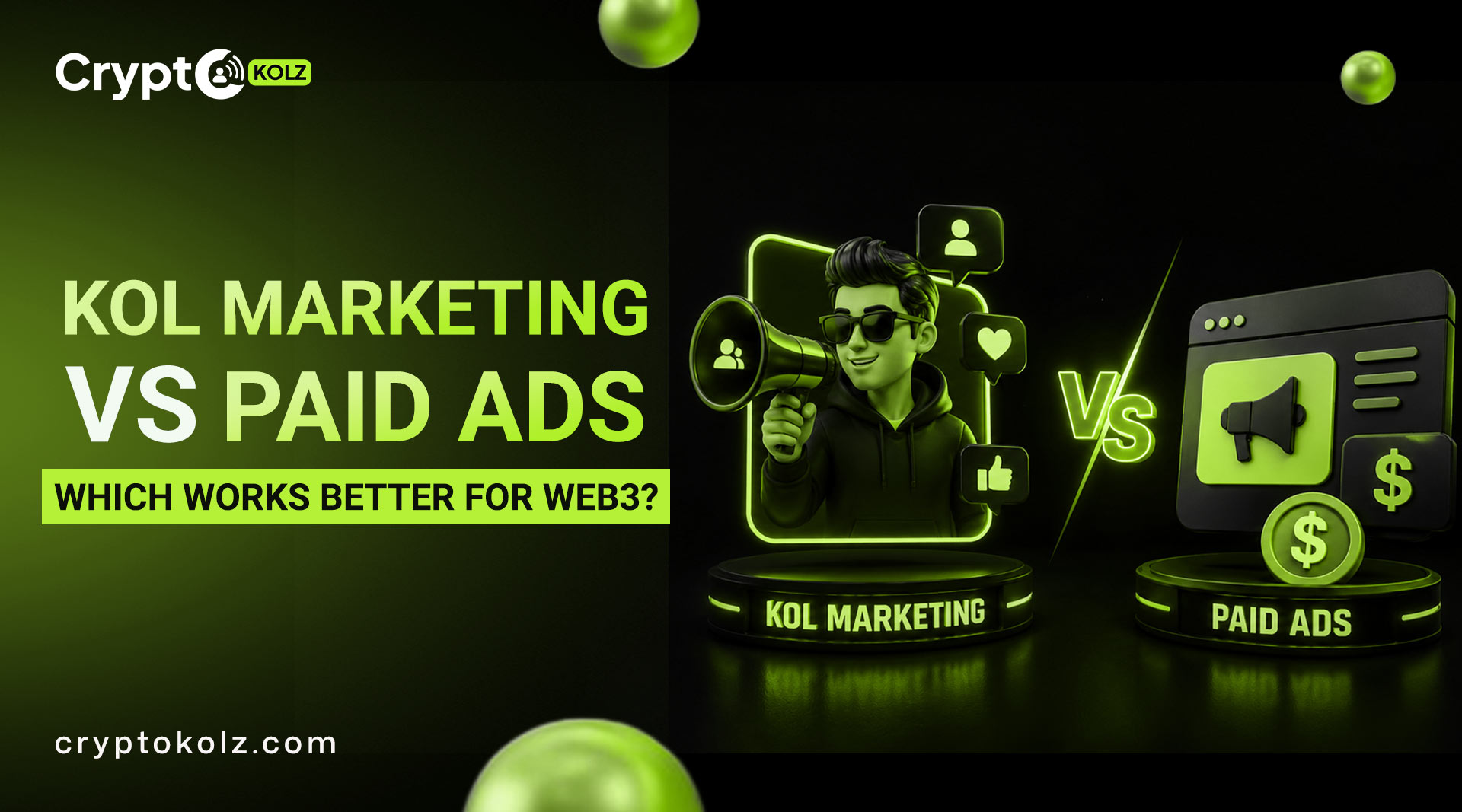
KOL Marketing vs. Paid Ads: Which Works Better for Web3?
Bootstrapping a Web3 audience is tougher than ever. Daily, the crypto sphere pumps out millions of X (Twitter) posts, TikTok reels, and Discord pings.
Start‑ups that choose the wrong growth channel often burn half their treasury before main‑net. Understanding KOL marketing vs paid ads is therefore not optional; it is an early survival decision.
Quick stat: DeFi projects that launched with a KOL‑first strategy in 2025 enjoyed a 17 % lower customer‑acquisition cost (CAC) than peers relying on banner networks (CreatorIQ Crypto Benchmarks, Q4 2025).
Channel Definitions (No Hype, Just Facts)
1. KOL Marketing
Partnering with Key Opinion Leaders credible domain experts who already educate niche communities.
Content formats: Long‑form threads, smart‑contract walkthroughs, AMAs, gated Discord sessions.
Primary goal: Trust and narrative control. Followers view the KOL as a technical filter, not a billboard.
Payment logic: Flat fee + performance bonus, or hybrid (stablecoins + vested tokens).
2. Web3 Paid Ads
Buying reach through programmatic display, search ads, or in‑app banners that accept crypto categories.
Content formats: Static banners, pre‑roll video, sponsored search placement.
Primary goal: Fast impressions, precision retargeting, and look‑alike audience expansion.
Payment logic: CPM (cost per 1000 impressions) or CPC (cost per click) plus platform fees.
3. How the Money Really Flows
In both channels, sticker price rarely equals true cost.
KOL marketing hidden costs
• Due diligence (bot check, compliance history).
• Script drafting and revision cycles.
• Legal review of every hashtag and disclosure line.
Paid‑ad hidden costs
• Creative‑approval iterations Google’s crypto‑ad queue can add seven days.
• Fraud filters that shave off 10–20 % of raw clicks.
• Regional compliance fees (e.g., Baidu blockchain licence in China).
Cost & Performance Snapshot
Metric (Q4 2025 – Q1 2026 median) | KOL Marketing | Paid Ads |
Average CAC | US $18 | US $23 |
30‑Day Retention | 31 % | 18 % |
Compliance Rejection Rate | 4 % | 12 % |
Speed to Launch | 10–14 days | 3 days |
(Sample of 38 campaigns across APAC, EU, LATAM)
Why KOLs Excel Beyond the Numbers
Social Proof Loop – A single quote‑tweet from a respected auditor can fold third‑party validation into your own thread, boosting legitimacy faster than any banner exchange.
Contextual Teaching – KOLs break down tokenomics, smart‑contract risks, and governance models in language their followers already trust.
Networked Distribution – Top crypto KOLs syndicate on multiple channels (X, Farcaster, Lens, YouTube Shorts), giving one fee multi‑platform reach.
Long‑Tail Engagement – Weeks after the campaign, new followers still discover the thread, pushing organic conversions long past the paid window.
6. Where Paid Ads Still Win
Speed: Need wait‑list sign‑ups this weekend? Paid ads are live in hours.
Scalability: Add $1 000 more budget and impressions jump instantly no DM negotiations needed.
Granular Retargeting: Wallet‑connect pixels allow you to serve fresh offers only to users who stalled at checkout.
Decision Matrix – Pick the Right Tool for Each Stage
Project Stage | Choose KOL‑First If… | Choose Ads‑First If… |
Pre‑launch | You need deep‑dive AMAs, early credibility, and code review. | You need 10 000 wait‑list emails within two weeks. |
Post‑TGE (Token Generation Event) | You aim for sticky holders, DAO participation, and narrative control. | Liquidity and rapid DEX volume are your top metrics. |
Mature dApp | You’re expanding to new chains and must educate unfamiliar users. | You’re retargeting dormant wallets with a time‑boxed incentive. |
Hybrid Playbook: One Timeline, Two Levers
Kick‑off with two micro KOLs (<50 k followers) to stress‑test the pitch. Their communities talk back fast, letting you catch jargon missteps.
Spin up a lean paid‑ad set that retargets anyone who clicked the KOL referral link but did not complete a wallet connection.
Layer in a macro KOL once CAC stabilises. This “K‑shape” investment curve prevents overpaying for reach too early.
Scale paid ads only in geos where KOL trust has primed awareness; otherwise CPCs rise with little retention.
Measuring ROI the Web3‑Native Way
Traditional web funnels stop at clicks. Web3 measurement follows the money on‑chain.
Step 1 – Tag traffic with UTM codes that echo inside a wallet‑connect URL.
Step 2 – Log first on‑chain action (swap, stake, vote) and tie wallet hash to referral source.
Step 3 – Assign event value (e.g., average staking revenue per user, protocol fee share).
Step 4 – Calculate Net ROI
Formula: (Total Event Value − Channel Cost) ÷ Channel Cost × 100Step 5 – Benchmark KOL vs paid‑ad cohorts after 30 and 90 days.
Need help? Our ROI Measurement explainer walks through setting up Dune dashboards and attribution contracts.
Common Pitfalls and How to Dodge Them
1. KOL Traps
Fake Followers: Run wallets through BotSentinel or TruthLabs analytics.
One‑off Shills: Insist on multi‑touch content (teaser + AMA + reminder) to avoid hit‑and‑run promos.
Disclosure Lapses: Provide pre‑written #ad tags that hit the first 30 characters to satisfy mobile truncation.
2. Paid‑Ad Traps
Geo Blocklists: Some exchanges block MetaMask domains, killing final‑step conversions test on VPNs first.
Creative Fatigue: Rotate visuals every 72 hours; crypto audiences scroll fast.
Compliance Drift: Google’s crypto policy updates quarterly; schedule reviews or risk sudden suspension.
Compliance & YMYL Safeguards
Always tag paid content (#ad, #sponsored) and list material connections.
Ban price or profit promises; frame tokens as high‑risk assets.
Cite up‑to‑date sources for stats; outdated or unsourced numbers fail E‑E‑A‑T checks.
Add an explicit disclaimer: “Educational content; not investment advice.
Conclusion
KOL marketing delivers trust, narrative depth, and stronger retention ideals when your product’s complexity demands explanation. Paid ads deliver speed, scale, and algorithmic targeting ideal when you must flood the top of the funnel or reignite dormant users.
The smartest Web3 teams in 2026 deploy both: validate with micro KOLs, amplify with targeted ads, and measure every step on‑chain.
By mapping each tactic to its natural strength and watching ROI rather than vanity clicks, you can stretch the treasury runway and build a community that sticks beyond launch day.
 Latest Blog
What is a Crypto KOL? The Role of Influencers in Blockchain Marketing
Latest Blog
What is a Crypto KOL? The Role of Influencers in Blockchain Marketing
The cryptocurrency world is growing fast. New projects launch every week, and thousands of tokens compete for attention. But not every project becomes popular or trusted. Success often depends on who is talking about it. This is where a crypto KOL (Key Opinion Leader) plays a big role.A crypto KOL is a person who influences how people think about blockchain and cryptocurrency projects. They help spread awareness, build trust, and guide investors toward new opportunities. In this article, you will learn what a crypto KOL is, why they matter, and how they help crypto projects succeed.What is a Crypto KOL?A...
 Latest Blog
Verified Crypto Influencers: How to Choose the Right Ones
Latest Blog
Verified Crypto Influencers: How to Choose the Right Ones
Finding verified crypto influencers is now one of the most important parts of any Web3 marketing plan. The crypto world moves fast, new projects launch every day, and users trust only a few voices they consider honest and reliable. If you want steady, long-term growth, you need influencers who are respected, transparent, and truly understand the industry.This guide will help you do exactly that. You’ll learn how to find trustworthy influencers, how to check if they are genuine, and how to choose the ones who match your project’s goals. The goal is simple: to help you make smart and safe...
 Latest Blog
Best Crypto Influencer Platforms for Web3 in 2026
Latest Blog
Best Crypto Influencer Platforms for Web3 in 2026
The crypto world changes fast new tools, fresh projects, and new ideas appear all the time. As the space continues to grow rapidly, the need for strong and simple crypto influencer marketing is bigger than ever. If you want to launch a token, promote an NFT drop, or grow a Web3 community, the right platforms can help you reach the right people in a clear, effective, and efficient way. Influencer marketing is no longer optional; it has become an essential part of any successful crypto campaign.This guide walks you through the best platforms for crypto influencer marketing. You’ll learn how...
 Latest Blog
Top Crypto Influencer Marketing Mistakes You Must Avoid
Latest Blog
Top Crypto Influencer Marketing Mistakes You Must Avoid
Crypto marketing is growing fast, and influencers have become a key part of promoting projects, tokens, and Web3 campaigns. Influencers can help you reach thousands of potential investors and users. But even with the best influencers, mistakes can hurt your project. They can waste money, reduce credibility, or fail to attract the right audience.In this guide, we will explain the most common crypto influencer marketing mistakes and show how to avoid them. By following these tips, your campaigns will be more effective, trustworthy, and successful.What Is Crypto Influencer Marketing in Blockchain?Crypto influencer marketing is when a cryptocurrency or blockchain project...
 Latest Blog
Crypto Guest Posting Tips to Boost Trust & SEO
Latest Blog
Crypto Guest Posting Tips to Boost Trust & SEO
Guest posting for crypto projects has become one of the most powerful tools for crypto projects that want to build trust, gain online visibility, and attract real investors. With thousands of new blockchain projects, token sales, and crypto startups launching every year, standing out has become harder than ever. This is why guest posting is now considered an essential strategy for improving SEO, increasing credibility, and driving long-term organic traffic.Explore, you will learn why guest posting matters for crypto projects, how it boosts trust, how it improves SEO, and how you can use it to grow your project faster than...
From account setup to troubleshooting, our FAQ section provides clear, concise solutions to help you navigate with ease. Save time and find the information you need instantly. Check out the FAQs now!